

Some names carry weight far beyond the letters that spell them. William is one of those names.
Whether you know a William, are raising one, or wear the name yourself you’ve probably never stopped to ask: what does Scripture say about this name? What does it mean spiritually? And why has it survived centuries, cultures, and continents without ever fading?
Here’s the thing. The biblical meaning of William isn’t tucked neatly into a single verse. It’s woven into the fabric of Scripture running through themes of divine protection, resolute faith, and a calling to guard what matters most. Let’s unpack it together.
Etymology: Tracing the Roots of William
Every great name has a story. William’s starts in ancient Germany, long before England existed as we know it.
The origin of the name William traces back to Germanic tribes who treated names as declarations of character and destiny not just convenient labels. The name traveled west, evolved across generations, and exploded in popularity after the Norman Conquest of 1066, when William the Conqueror crossed the English Channel and reshaped an entire civilization. Within a generation, William became the most common name in England. It never really stopped being popular.
Today, across the USA, the William name meaning and legacy live on in presidents, reformers, and ordinary people doing extraordinary things. But the real story isn’t historical. It’s spiritual.
The Germanic Elements of “Wil” and “Helm”
Break Wilhelm the original Germanic name into two parts and everything clicks.
| Element | Language Origin | Core Meaning |
|---|---|---|
| Wil | Old High German | Will / Desire / Determination |
| Helm | Old High German | Helmet / Protection / Guardian |
| Wilhelm (combined) | Germanic | Resolute Protector / Strong-Willed Guardian |
Wil isn’t passive. It speaks to fierce, intentional resolve the kind that gets you up before dawn and keeps you standing when everyone else has sat down. Helm points directly to a war helmet physical protection, yes, but also the posture of someone guarding others at personal cost.
Put them together? You get a resolute protector. A strong-willed guardian. Someone whose determination is inseparable from their calling to shield those around them. The Wilhelm name meaning carries both grit and grace and that combination is deeply, unmistakably biblical.
Read This Article: Biblical Meaning of the Name EVELYN
Symbolism of Resolute Faith and Protection
Names weren’t casual in the ancient world. Hebrew parents named their children as prophetic declarations. Germanic and Greek cultures did the same. A name wasn’t just an identifier it was a destiny written in sound.
The Christian symbolism of William sits at the intersection of two massive biblical themes:
- Will the surrendering of human desire to God’s sovereign purpose
- Helm the calling to extend divine protection and covering to others
In Matthew 6:10, Jesus teaches: “Your will be done.” That single phrase captures the entire spiritual weight of the wil element. And in Ephesians 6:17, Paul calls believers to take up “the helmet of salvation” directly echoing the helm at the heart of this name. The helmet of salvation symbolism isn’t coincidental. It’s a direct biblical bridge connecting this name’s Germanic roots to New Testament truth.
Spiritual Meaning of William in the Bible

William doesn’t appear in Scripture by name. But its spiritual DNA? Absolutely everywhere.
“Here am I, send me.” Isaiah 6:8
That’s a William statement. Willingness. Resolve. A readiness to step into whatever God calls you toward even when it’s uncomfortable or costly.
Ezekiel 22:30 adds another layer: “I looked for someone among them who would build up the wall and stand before me in the gap.” That’s the helm calling Christian spiritual guardianship in its purest form. Someone willing to stand between danger and the people they love, not because it’s convenient, but because it’s their calling.
The name William spiritual meaning isn’t just a doctrine. It’s a lifestyle. It’s what happens when determination meets devotion and both are surrendered fully to God.
William in Biblical Context
In Hebrew culture, names shaped destiny. Abram became Abraham. Jacob became Israel. Renaming wasn’t cosmetic it was transformation. The biblical symbolism of names is one of Scripture’s most consistent threads, running from Genesis all the way through Revelation.
When you understand that thread, the spiritual significance of the name William comes into sharp focus.
William’s characteristics show up in some of the Bible’s most iconic figures:
- David A shepherd-turned-warrior-king whose resolute faith in the face of Goliath defined a generation. A fierce protector whose will was ultimately surrendered to God’s purposes.
- Daniel Thrown into Babylon, surrounded by hostile opposition, he refused to compromise his faith. Christian faith and resilience personified the Daniel in the lions’ den story is a masterclass in standing firm.
- Joseph Betrayed, enslaved, imprisoned, forgotten yet spiritually unbroken throughout. His story is perhaps the clearest picture in the Old Testament of trusting God’s providence when the path makes absolutely no sense.
These men didn’t share the name William. But they lived its meaning every single day.
Embodying Strength and Resilience
Biblical resilience is never passive. Romans 5:3-4 makes that crystal clear suffering produces perseverance; perseverance, character; and character, hope. That’s an active, sometimes painful, always purposeful process.
The wil element of William speaks to an inner drive that simply won’t quit. It’s not stubbornness it’s biblical courage and protection fueled by genuine faith.
Consider William Wilberforce a real-life William whose resolute faith helped dismantle the British slave trade. He was mocked, exhausted, politically outgunned, and physically ill for much of his career. He kept going anyway. His wil was anchored to something far bigger than personal comfort.
“Be strong and courageous. Do not be afraid; do not be discouraged, for the Lord your God will be with you wherever you go.” Joshua 1:9
That verse was written for people like William. People whose resolve gets tested daily and who choose, again and again, to remain standing.
Biblical Meaning of the Name William
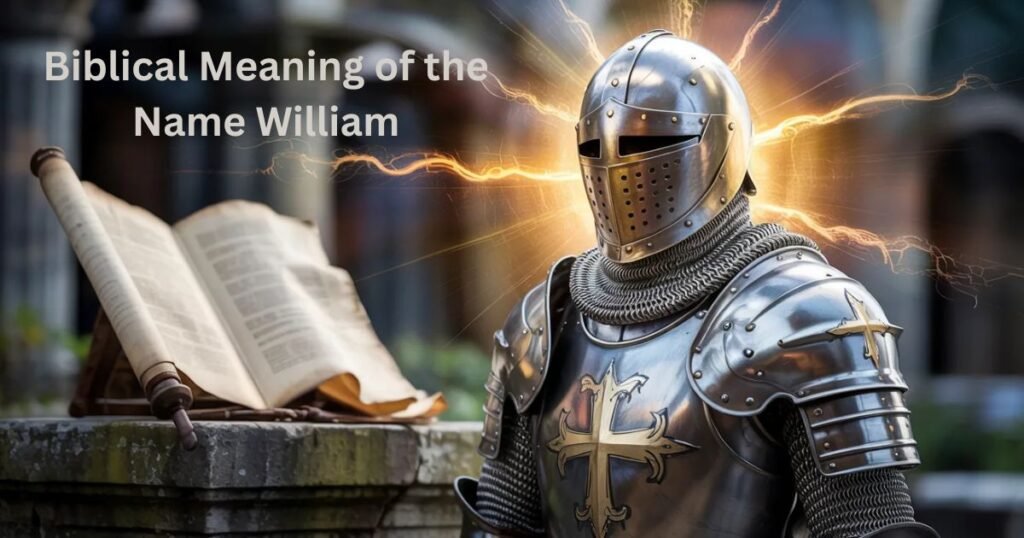
Pull it all together and here’s what the biblical meaning of the name William gives us: a person called to three distinct spiritual mandates.
- Will A deep, surrendered desire for God’s purposes above personal agendas
- Helm A protective calling over family, community, and the faith itself
- Resolve An unwavering determination that doesn’t fold under pressure
Proverbs 18:10 captures it beautifully: “The name of the Lord is a fortified tower; the righteous run to it and are safe.” The Proverbs 18:10 strong tower imagery is exactly the kind of presence a William is called to embody a safe place, a firm foundation, a guardian of the faith in whatever sphere God places them.
William in Hebrew Meaning
Hebrew doesn’t offer a direct translation of William. But the concepts inside the name appear beautifully throughout the Old Testament.
| Hebrew Concept | Hebrew Word | Biblical Connection to William |
|---|---|---|
| Will / Heart’s Desire | לֵב (Lev) | The seat of desire and decision (Proverbs 4:23) |
| Protection / Shield | מָגֵן (Magen) | God as shield Psalm 3:3, Psalm 84:11 |
| Strength / Might | עֹז (Oz) | Spiritual fortitude Psalm 46:1 |
The closest Hebrew names with similar meaning include Gabriel (“God is my strength”) and Ariel (“lion of God”) both carrying the guardian-protector archetype that defines the William name meaning in Hebrew context. Abielle (“God is my father/strength”) also resonates deeply with William’s spiritual DNA.
In Hebrew thought, a willing servant wasn’t merely compliant. Their lev their very heart was actively aligned with God’s. That alignment is the whole point of the name. William pronunciation in Hebrew doesn’t have a standardized form, but the closest rendering is Wil-yam (ויליאם), borrowing the phonetic structure while reaching for the spiritual substance.
What Does the Name William Mean in Greek
Greek opens another fascinating window into the spiritual meaning of William.
The New Testament word thelema (θέλημα) means will or desire and it appears 62 times in the Greek NT alone. Jesus uses it in Gethsemane: “Not my will (thelema), but yours be done” (Luke 22:42). That single moment captures everything the wil in William points toward the most profound act of will in human history was an act of complete surrender.
For the helm element, Greek gives us phylax (φύλαξ) a guard or protector and peripoiesis the concept of God’s own possession, something carefully kept and guarded. William meaning in Greek context carries both surrender (thelema) and guardianship (phylax) two forces that only work together when rooted in genuine faith.
William Name Meaning in Urdu
For Pakistani Christians and the broader South Asian diaspora across the USA, the name William written in Urdu script as ولیم carries significant spiritual resonance.
The Arabic-rooted concept of wali (وَلِيّ) meaning guardian, protector, or friend of God sits remarkably close to William’s Germanic core. In spiritual tradition, a wali is someone drawn near to the divine and entrusted with guardianship over others. Pakistani Christians who carry the name William often embrace it precisely because its meaning translates so cleanly across their theological framework.
Across Spanish (Guillermo), Italian (Guglielmo), and Scandinavian (Vilhelm), the European variations of William all preserve the same essential meaning. That cross-cultural consistency isn’t accidental it points to something universally true about the human need for resolute, faithful protectors.
Embracing the Characteristics of William
A name doesn’t just describe you. It challenges you. Whether you go by Will, Bill, Billy, Liam, or simply Williams this name sets a standard worth chasing.
Cultivating Resolute Faith and Determination
Resolute doesn’t mean stubborn. It means you’ve decided and you don’t un-decide just because circumstances get hard.
Hebrews 11:1 defines faith as “the substance of things hoped for.” Notice: substance. Something real. Something you act on. Christian determination and faith isn’t a feeling you wait for it’s a posture you choose every single day.
Here’s what cultivating that kind of resolve looks like practically:
- Daily Scripture anchoring Start in the Word before the noise of the day takes over
- Prayer before panic When anxiety rises, go to God first (Philippians 4:6-7)
- Obedience in small moments Resolve is built in the mundane, not just the dramatic
- Community accountability People living the William calling need others who will speak truth into their lives without softening it
Philippians 4:13 “I can do all things through Christ who strengthens me” is a daily declaration for someone living out the wil in their name. It’s not a motivational poster. It’s a covenant promise for Christian spiritual disciplines practiced faithfully over a lifetime.
Serving as Spiritual Protectors and Guardians
The helm element is relational. It turns a William’s attention outward toward the people in their sphere who need covering, protection, and consistent presence.
Christian spiritual guardianship takes many real-world shapes:
- Fathers who pray daily over their children and guard their family’s spiritual atmosphere
- Mentors who shield younger believers from theological deception and poor decisions
- Leaders who stand between their communities and moral compromise
- Friends who show up uninvited because someone needed a safe presence
Psalm 91:4 paints the picture precisely: “He will cover you with his feathers, and under his wings you will find refuge.” The Psalm 91:4 protection imagery describes the guardian posture not absent, not passive, but present and purposefully protective. That’s divine protection in Scripture made visible through human faithfulness.
Nurturing a Trusting Heart
Here’s the tension every William eventually faces. You’re wired to protect, but you can’t protect everything. The harder you try to control outcomes, the further you drift from the Source of all protection.
Isaiah 41:10 speaks directly here: “Do not fear, for I am with you; do not be dismayed, for I am your God. I will strengthen you and help you; I will uphold you with my righteous right hand.” That’s not a passive comfort. It’s an active declaration of God’s sovereign care over every situation that feels out of control.
A trusting heart isn’t weak. It’s actually the strongest spiritual posture available.
Surrendering Control to God’s Providence
God’s providence is the theological reality that nothing escapes His care and oversight. Every William who’s ever tried to hold everything together eventually learns this lesson often the hard way.
Proverbs 3:5-6 is the landmark verse: “Trust in the Lord with all your heart and lean not on your own understanding; in all your ways submit to him, and he will make your paths straight.”
Here’s a practical framework for surrendering to God’s will:
- Name what you’re gripping Identify the specific area you’re trying to control
- Swap anxiety for prayer Philippians 4:6 is a spiritual exchange mechanism, not just nice advice
- Act obediently without full clarity Surrender doesn’t mean waiting for a complete map; it means trusting the Guide
- Return to Psalm 138:2 God is faithful to His character even when your circumstances feel chaotic
Think of it this way. A GPS is useless when you keep overriding the route. Trusting God’s providence means letting Him navigate especially when His route looks nothing like yours.
Embracing God’s Calling as William

Every name carries a calling. William’s calling is both ancient and urgently relevant.
The Christian meaning of William isn’t nostalgic it’s prophetic. In a culture that rewards self-promotion and punishes deep commitment, being a resolute protector is countercultural. It’s costly. And it’s precisely what families, churches, and communities need right now.
Living out biblical values as a William means:
- Choosing God’s will over personal preferences consistently, not just in crisis moments
- Standing in the gap for people who can’t stand for themselves
- Bringing spiritual covering into your home, workplace, and community
- Being the kind of person others feel safer around simply because you’re present and faithful
God’s plan for every William every Will, Bill, Liam, and Billy is intentional. Christian identity through names isn’t superstition. It’s an invitation to align your life with a purpose larger than yourself.
“For I know the plans I have for you, declares the Lord, plans to prosper you and not to harm you, plans to give you hope and a future.” Jeremiah 29:11
You don’t need a platform. You don’t need a title. You just need a willing heart and a firm grip on the One who called you.
FAQs
What is the biblical meaning of William?
The biblical meaning of William centers on being a resolute protector someone whose strong will is surrendered to God’s purposes and whose calling is to guard and cover those around them. While the name doesn’t appear in Scripture directly, its meaning aligns powerfully with biblical themes of divine protection, courageous faith, and spiritual strength.
Does the name William appear in the Bible?
No William doesn’t appear in the Bible by name. However, its core spiritual themes of willingness, protection, strength, and guardianship run consistently throughout both the Old Testament and New Testament.
What does William mean spiritually?
Spiritually, the name William spiritual meaning points to a person called to determined faith and the active protection of others under God’s authority. It combines human resolve (wil) with divine covering (helm).
What is the Hebrew meaning of William?
There’s no direct Hebrew equivalent, but lev (heart/will), magen (shield/protection), and oz (strength) closely mirror William’s core meaning. Names like Gabriel, Ariel, and Abielle share the same guardian-protector spiritual DNA.
What does the name William mean in Greek?
In Greek, thelema (will/desire) and phylax (guard/protector) together capture William’s full meaning surrender to God’s will plus active guardianship of others.
Is William a strong name in Christianity?
Absolutely. The William name meaning in Christianity reflects some of the faith’s most central values courageous determination, selfless protection, and a life surrendered to God’s calling. Christians named William have shaped theology, justice, and culture for centuries.
What are the main variants of William across cultures?
The name appears as Guillermo in Spanish, Guglielmo in Italian, Vilhelm in Scandinavian languages, and Wilhelm in German. In Urdu, it’s written ولیم. Across every language and culture, the core meaning resolute protector remains beautifully intact.